Carrier Fault Codes for Alhambra Homeowners
Answer first: Alhambra Carrier HVAC decodes Carrier fault codes for homeowners across Alhambra, CA (Emery Park, ZIP 91801), so call (213) 799-8423 or book online to get a code diagnosed. Furnaces flash two-digit amber codes (13, 14, 31, 34) and Infinity systems show comm faults 178 and 179 in plain-language text.
Facts that matter
- Carrier code diagnostics across Alhambra (91801, 91803).
- Furnace codes are short/long amber flashes; Infinity shows them on screen.
- Communication faults: 178 indoor, 179 outdoor.
- Furnace lockouts: 13 limit, 14 ignition, 33 limit fault, 45 control.
- 31 pressure switch, 34 flame proving, 26 rollout (safety).
- Cooling codes: 44 airflow restriction, 54/56 sensors, 73 run-cap voltage.
- 180/184/187/286/288 are model strings, not fault codes.
- Independent shop; in-warranty units referred to an authorized dealer.
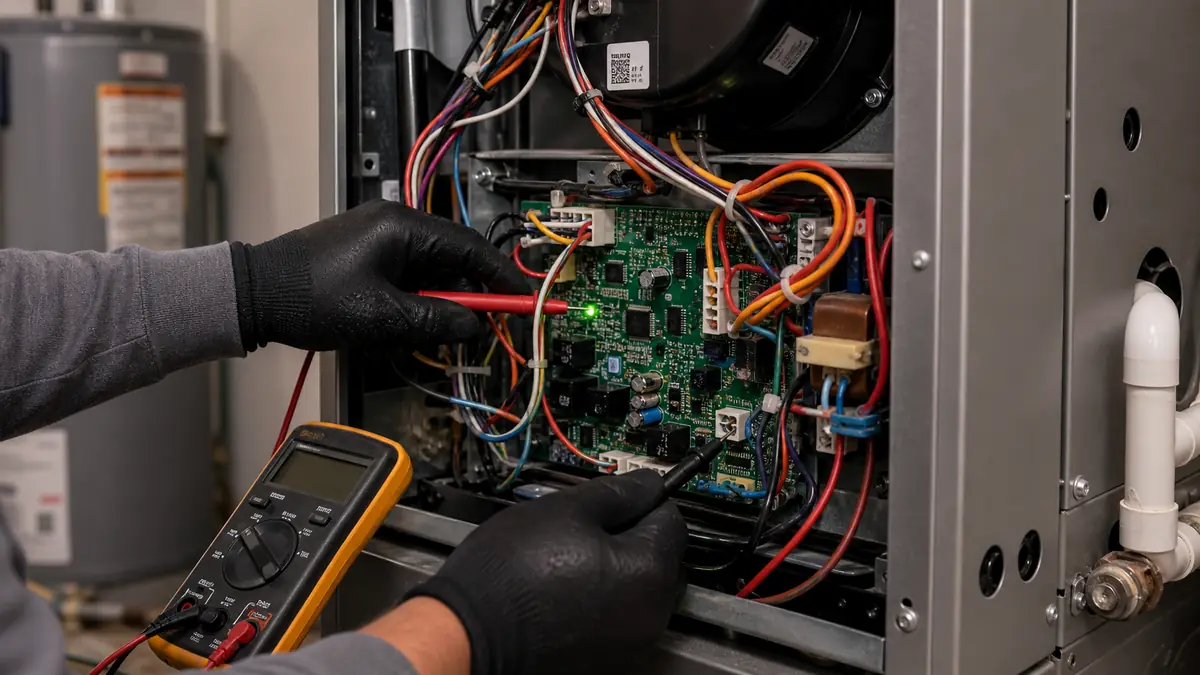
What do the common Carrier codes mean?
Carrier furnaces and Infinity systems report two families of codes: furnace control-board codes (counted as amber flashes) and Infinity communicating-system codes (shown on the touchscreen). Knowing which one you have tells us where to look before the truck even arrives in your part of Alhambra.
| Code | Meaning | Likely cause / first check |
|---|---|---|
| 13 | Limit circuit lockout | Overheating: dirty filter, blocked vent, low airflow |
| 14 | Ignition lockout (hard) | Failed igniter, no gas, dirty flame sensor |
| 26 | Rollout switch open | Inspect heat exchanger - safety stop |
| 31 | Pressure switch fault | Inducer, blocked flue, stuck switch |
| 33 / 34 | Limit fault / ignition proving | Recurrent overheat / weak flame sensor |
| 44 | Air-delivery restriction | Dirty filter or ductwork (cooling/airflow) |
| 54 / 56 | Suction / OAT-OCT sensor | Failed thermistor on Infinity system |
| 73 | Voltage at run cap, no call | Contactor, relay, or wiring (24ANA/25HNA) |
| 178 / 179 | Indoor / outdoor comm fault | ABCD wiring, wet board, lost line voltage |
Why do communication faults hit Alhambra Carrier systems?
The 178 and 179 comm faults show up most after weather. The San Gabriel Valley gets short, intense winter rain bursts, and water finds its way to the outdoor control board's ABCD terminals on a 27VNA or 24VNA unit if the conduit was not sealed well. Rodents in the dense older neighborhoods occasionally chew the low-voltage harness too. We trace each of the four wires, ohm out the boards, and reseal the entry point so the fault does not return with the next storm. The plain-language text on the Infinity System Control tells us indoor versus outdoor before we open anything.
What can I check before calling on a code?
A few codes have a safe homeowner first move. A 13 or 33 limit lockout most often traces to a filter so clogged the furnace overheats - swap it, cut the power for a minute to clear the lockout, and watch one full cycle. A 14 that follows a gas outage may just need the lockout reset once the supply is back. A 31 pressure-switch code on a windy day can be a downdraft through the flue. But do not bridge a pressure switch, jump a rollout, or defeat any safety to force a run - those switches exist to stop combustion gas problems. And a 26 rollout is never a reset-and-go: leave it off and book an inspection. The codes that point at a board (178/179, 45) or a tripping breaker are diagnostic-meter territory, not a homeowner fix.
Which codes are cheap and which are serious?
Most furnace codes are inexpensive - a 14 is usually a $150 to $450 igniter, a 34 is a flame sensor cleaning, a 13 is often just a filter. The expensive lane is a communicating board (178/179) at $400 to $2,000 or a compressor behind a tripping breaker at $1,200 to $3,500. The safety stop is code 26: a rollout trip means we inspect the heat exchanger before the furnace runs again. For the cooling side, jump to AC not cooling; for heat, see no heat.
Deep dives on two common Alhambra codes
Two codes come up enough in Alhambra homes to earn their own walkthrough. A Carrier 31 code is a pressure-switch or draft fault - the inducer is not proving draft, often from a flue blocked by foothill leaf litter or a plugged condensate trap on a 90-percent furnace. A Carrier 44 code is excessive air-delivery restriction on an Infinity system, usually a clogged filter, closed damper, or the undersized retrofit ductwork common in 1920s cottages here. Each page covers the diagnostic readings, safe homeowner checks, and the Alhambra cost lanes.
Common questions
How do I read a Carrier furnace flash code?
Open the furnace access panel and watch the amber LED on the control board. Carrier uses a two-digit pattern: short flashes for the first digit, long flashes for the second. Three short plus four long is code 34. On an Infinity system the same code shows on the touchscreen with a plain-language line, so you do not have to count flashes.
Are 180, 184, 187, 286, and 288 Carrier fault codes?
No - and this trips up a lot of homeowners. Those strings are Carrier outdoor unit model and series references (24ANA/25HNA families), not fault codes. The only genuine communication fault codes are 178 (indoor) and 179 (outdoor). If you saw one of those model numbers, you were reading a nameplate, not a fault.
My Carrier code cleared itself - is the problem gone?
Not necessarily. Many Carrier faults are stored as history even after the system recovers. A 13 limit lockout that cleared often means a dirty filter let the furnace overheat once; it will repeat. We can pull the stored fault history on an Infinity control to see intermittent faults you might miss in real time.
Which Carrier codes mean I should stop using the system?
Code 26, a rollout switch trip, is the one to take seriously - it can indicate a cracked or overheated heat exchanger that may leak combustion gases. Shut the furnace off and call. A breaker that keeps tripping on the AC side also means stop resetting it; something is drawing fault current.