Emergency Carrier AC Repair in Alhambra, CA
Answer first: Alhambra Carrier HVAC runs on-call emergency AC repair across Alhambra, CA, including the Bean Tract and ZIP 91801, carrying run capacitors and contactors on the truck for fast same-day no-cool fixes on 26-series Carrier condensers - so call (213) 799-8423 now or book online for the next window. Most heat-wave failures are a $150 to $450 capacitor or contactor, not a dead compressor.
Facts that matter
- On-call no-cool help across Alhambra, 91801 and 91803.
- Most heat-wave fixes: run capacitor or contactor, $150 - $450.
- Capacitors and contactors stocked on the truck for same-day repair.
- Alhambra runs 40 - 60 days a year at or above 90 F.
- After-hours rate quoted before dispatch, often credited to the repair.
- Weekday hours 6am - 8pm; emergency line on call beyond that.
- Carrier-focused; in-warranty units referred to an authorized dealer.
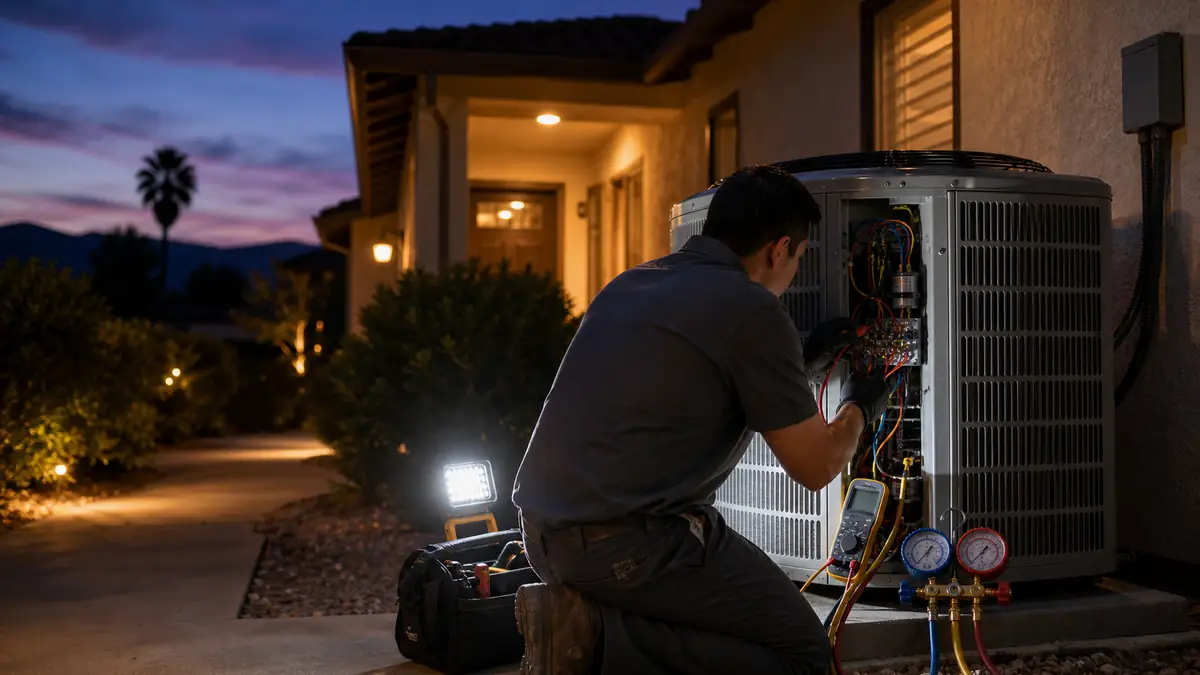
When should I treat a dead AC as an emergency?
Alhambra's heat-island effect - dense urban fabric two miles east of downtown LA - pushes indoor temperatures past safe levels fast on a 93 F afternoon, especially for older residents in pre-war homes without good insulation. A fully dead system on a heat day, a breaker that will not stay set, a scorched smell, or water dripping through a ceiling all warrant an on-call visit. The pages on AC not cooling and short cycling help you tell a true emergency from a nuisance.
What fails first in an Alhambra heat wave?
Heat stress hits the electrical parts first. Capacitors lose capacitance and stop starting the fan or compressor; contactors pit and weld shut; older R-410A systems with a slow leak finally run out of charge during the highest-demand week of the year. Those are exactly the parts we keep on the truck.
| Emergency symptom | Likely cause / first check | Typical cost lane |
|---|---|---|
| Total no-cool, condenser hums | Failed run capacitor | $150 - $450 |
| No-cool, no sound at all | Welded contactor or tripped float switch | $150 - $450 |
| Cools then warms, ice on coil | Low refrigerant from a leak | $225 - $1,500 |
| Breaker trips on start | Compressor locked rotor | $1,200 - $3,500 |
| Water through the ceiling | Clogged condensate drain or failed pump | $150 - $600 |
How does an emergency Carrier AC call go?
We work an emergency in a tight, fixed order so the most common heat-wave failures get fixed on the first visit:
- Phone triage. We ask what the unit is doing - humming, silent, tripping the breaker, leaking - and quote the after-hours rate before anyone rolls. That tells us which parts to stage.
- Power and signal check. On arrival we confirm the breaker, disconnect, and 24V call, and check the float switch. A surprising number of "dead" units are a full condensate pan tripping the safety.
- Electrical readings. Capacitor microfarads against the nameplate, contactor condition, compressor and fan amp draw. On an Infinity unit we read the touchscreen code (44, 54/56, 178/179) first.
- Stabilize or fix. A capacitor, contactor, or fan motor we carry gets swapped on the spot. A compressor or communicating board that needs ordering, we stabilize what we can and set a firm return time so you are not left guessing.
- Verify cooling. Before we leave, we confirm an 18 to 22 degree split across the coil and amp draw back in spec - real cooling, not just a unit that spins.
Who is most at risk when an Alhambra AC dies in the heat?
The local angle here is not abstract. Alhambra's wall-to-wall 1920s and 1930s housing was built without insulation by modern standards, and the dense urban grid two miles east of downtown LA traps heat into the evening. On a 93 F afternoon, an uninsulated Emery Park bungalow can climb past 90 F indoors within a couple of hours of the system quitting. That is a genuine health risk for older residents, infants, and anyone with a heart or respiratory condition - the groups public-health agencies flag first during a heat advisory. That is the line between a true emergency that gets an on-call truck and a nuisance that can wait for a same-week slot.
What does emergency service cost in Alhambra?
An after-hours or weekend visit carries a higher service-call rate than a scheduled weekday diagnostic - we quote it before dispatch, never after, and it is usually credited toward the repair if you approve the work. Beyond the trip, the part lanes are the same as a daytime call: a capacitor or contactor runs $150 to $450, a condenser fan motor $400 to $800, a refrigerant leak repair $225 to $1,500, and a compressor $1,200 to $3,500 (far less if the 10-year parts warranty is live). Because most heat-wave failures land in that bottom capacitor-and-contactor lane, an emergency call is usually a few hundred dollars to get cooling back, not a four-figure shock.
One honesty note specific to emergencies: if your Carrier system is young and still under its parts warranty, a failed compressor or communicating board is cheapest through a manufacturer-authorized dealer, even though that channel is slower than an on-call independent. We will tell you that plainly on the phone. For a same-day capacitor or contactor failure - the overwhelming majority of heat-wave no-cool calls - warranty does not change anything, because those wear parts are not covered and the value is in getting a truck out fast.
What can I do before the truck arrives?
Turn the system off at the thermostat to let a frozen coil thaw and to stop a struggling compressor from drawing damaging amps. Swap a dirty filter if you have a spare. Close blinds on the west and south sides where Alhambra's afternoon sun loads the house. Keep pets and clutter away from the indoor air handler and the outdoor condenser so we can get straight to work. Do not keep resetting a breaker that trips - that is the unit telling you something is shorted.
Common questions
What counts as an HVAC emergency in Alhambra?
A dead AC during a 90 F-plus heat day, a burning smell from the furnace, a tripping breaker you cannot reset, or water pouring from an indoor unit onto a ceiling. Those get on-call priority. A thermostat that reads two degrees off or a noisy fan can usually wait for a same-week slot.
Can you really fix a no-cool emergency the same day?
Often, yes. The most common Alhambra heat-wave failure is a baked-out run capacitor or a welded contactor on a 26-series Carrier condenser, and we stock both on the truck. If it is a compressor or a communicating board that needs ordering, we will stabilize what we can and give you a firm return time.
Is there an after-hours fee for emergency service?
Emergency and after-hours visits carry a higher service-call rate than a scheduled weekday diagnostic. We quote that rate before we roll, never after. The fee is usually credited toward the repair if you approve the work, same as a standard call.
What should I do while I wait for the technician?
Shut the system off at the thermostat so a frozen coil can thaw and a struggling compressor stops drawing locked-rotor amps. Replace a clogged filter if you have one. Pull shades on the west side - Alhambra's late-afternoon sun drives indoor temps up fast. Then keep the area around the indoor and outdoor units clear for access.
My breaker keeps tripping - can I just keep resetting it?
No. A breaker that trips on AC startup is telling you something is shorted or the compressor is drawing locked-rotor amps, and repeatedly resetting it can damage the compressor windings or start an electrical fire. Leave it off and call us. We measure the amp draw and insulation resistance to find whether it is a hard-start issue, a grounded compressor, or a wiring fault.
Water is pouring from my indoor unit onto the ceiling - is that an emergency?
Yes, because it can ruin drywall and breed mold fast. It usually means a clogged condensate drain or a failed condensate pump backing up the pan. Shut the system off to stop the flow, put a bucket under the drip, and call us. Clearing the drain or replacing the pump typically lands in the $150 to $600 lane.