Carrier AC Repair in Alhambra, CA
Answer first: Alhambra Carrier HVAC repairs Carrier air conditioners across Alhambra, CA, including Emery Park and ZIP 91801, diagnosing no-cool calls on 26-series condensers - capacitor, contactor, compressor, refrigerant, and ECM blower faults, plus 178/179 comm and 73 voltage codes - so call (213) 799-8423 or book online for same-week service. The most common summer fix is a baked-out run capacitor, $150 to $450 installed, often closed in under an hour.
Facts that matter
- Carrier AC repair across Alhambra, 91801 and 91803.
- Most common summer fix: run capacitor, $150 - $450 installed.
- We service 26VNA, 26TPA, 26SPA, and 26SCA condenser families.
- Diagnostic $109 - $200, usually credited toward an approved repair.
- Refrigerant work: R-410A around $50 - $80 per pound installed.
- Compressor replacement $1,200 - $3,500; lower if still under warranty.
- Hours: Weekdays 6am-8pm, emergency service on call.
- Independent shop; in-warranty units referred to an authorized dealer first.
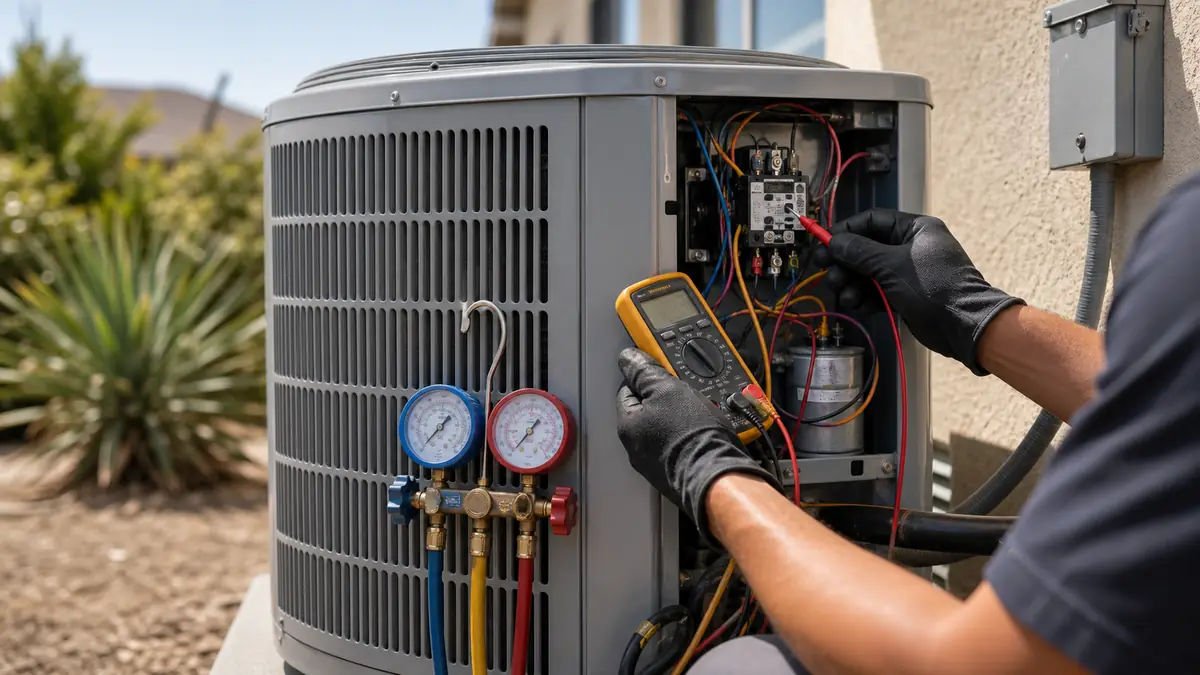
What usually breaks on a Carrier AC in Alhambra?
In a Zone 9 heat pocket two miles east of downtown LA, Carrier condensers fail in a predictable order. The dual-run capacitor goes first - it is a cheap part that bakes out after 40 to 60 days a year above 90 F. Next is the contactor, whose contacts pit and weld from repeated high-amp pulls. Then the condenser fan motor, then refrigerant leaks at the service valves or coil, and last the compressor. A no-cool call on a 26SCA5 Comfort 16 or 26TPA8 Performance 18 is far more likely to be a $200 capacitor than a $3,000 compressor, which is why we never quote a replacement over the phone.
On variable-speed Infinity condensers like the 24VNA6 or 26VNA1, the Greenspeed inverter and communicating board add a second class of failure: a 178 or 179 communication fault, where the ABCD wiring between the outdoor unit, indoor board, and Infinity System Control drops out. Water-damaged boards are common after the brief but intense winter rains the SGV gets.
How do you diagnose a Carrier no-cool call?
We start at the thermostat and the disconnect, not the refrigerant gauges. If the Infinity touchscreen shows a numeric code, that points us straight to the fault. On non-communicating Performance and Comfort units there is no code, so we measure: capacitor microfarads against the nameplate, contactor coil voltage, compressor amp draw, and superheat/subcooling only if the electrical side checks out. This order keeps you from paying for refrigerant when the real problem was a $25 part.
| Symptom | Likely cause / first check | Typical cost lane |
|---|---|---|
| Hums, outdoor fan will not spin | Failed dual-run capacitor; check microfarads against nameplate | $150 - $450 |
| Clicks, then nothing | Pitted or welded contactor | $150 - $450 |
| Runs, warm air, long cycles | Low refrigerant leak or dirty coil; Infinity code 44 airflow | $225 - $1,500 |
| Iced indoor coil | Restricted airflow or low charge; check filter and TXV/EXV | $225 - $1,500 |
| "Communication fault" on Infinity | Code 178 indoor / 179 outdoor; ABCD wiring or wet board | $150 - $2,000 |
| Voltage at cap, no compressor (code 73) | Contactor, relay, or 24V wiring on 24ANA-style unit | $150 - $450 |
| Weak airflow, no obvious cause; code 54/56 | Suction or OAT/OCT thermistor out of range | $200 - $600 |
| Breaker trips on start | Compressor drawing locked-rotor amps | $1,200 - $3,500 |
How does a Carrier AC repair actually go?
A repair in 91801 follows the same disciplined sequence every time, so you are not paying for guesswork. Here is the order a tech works:
- Confirm the call. We verify the thermostat is calling for cool, the breaker and disconnect are closed, and the 24V signal is reaching the contactor. A surprising share of "dead" units are a tripped float switch or an open disconnect a prior tech left.
- Read the codes. On an Infinity system the touchscreen shows a numeric fault (44 airflow, 54/56 sensor, 178/179 comm) plus plain language. On a Performance or Comfort unit there is no code, so we diagnose electrically.
- Measure the electrical side. Capacitor microfarads against the 45/5 or 35/5 nameplate, contactor coil voltage and contact condition, compressor and fan amp draw against the rated load amps on the data plate.
- Check refrigerant only if the electricals are clean. We connect gauges, read suction and liquid pressures, and calculate superheat and subcooling. Low subcooling with high superheat says undercharge or a leak, not a part to replace.
- Make the fix and verify. Swap the failed part, restart, and re-measure - split across the coil, amp draw back in spec, supply air 18 to 22 degrees colder than return. We do not call it done on a hunch; we call it done on the numbers.
The instruments that matter on the truck: a true-RMS meter with a capacitance range, a clamp ammeter, a manifold or digital probe set, and an electronic leak detector for refrigerant work. That toolkit is why a capacitor call closes in under an hour while a slow flare leak takes longer.
Which Carrier AC families do you repair in Alhambra?
Carrier splits residential cooling into three tiers, and each fails a little differently:
- Comfort (26SCA4 Comfort 14, 26SCA5 Comfort 16). Single-stage value condensers, the most common box on older Alhambra replacements. Simple 24V controls; failures are almost always capacitor, contactor, or fan motor - the cheapest tier to repair.
- Performance (26SPA6 Performance 16, 26TPA8 Performance 18, plus the ...C Coastal corrosion-protected variant). Single- and two-stage. The two-stage 26TPA8 adds a second contactor stage and better humidity control but no communicating board, so it still diagnoses electrically.
- Infinity (26VNA1 Infinity 21, 24VNA6 Infinity 26). Greenspeed variable-speed inverter condensers that modulate 25 to 100 percent. These carry the inverter PCB and ABCD communication wiring, so they add the 178/179 comm faults and the higher-cost board replacements a single-stage unit never sees.
Knowing which family is on the pad tells us before we open a panel whether we are chasing a $25 capacitor or a $900 communicating board.
What does a Carrier AC repair cost in Alhambra, and why?
The headline range is wide because the parts are wide. Here is how the lanes break down for a 2026 SoCal job, and what drives each:
- Diagnostic, $109 to $200. Covers the trip and full workup; usually credited toward an approved repair. SoCal labor and fuel sit above the national average, which sets the floor.
- Capacitor or contactor, $150 to $450. The part is $10 to $45; the cost is the trip and labor. These are the parts our heat bakes out fastest, so this is the single most common Alhambra repair.
- Condenser fan motor, $400 to $800. A matched motor plus a new capacitor, balanced and amp-checked.
- Refrigerant leak repair plus recharge, $225 to $1,500. Leak search runs $100 to $330; R-410A is roughly $50 to $80 per pound installed and climbing as the industry shifts to R-454B. A flare-joint reseal is cheap; a leaking evaporator coil is not.
- Communicating/inverter board, $400 to $2,000. Infinity boards are the part itself, often $120 to $800-plus, plus the labor to reseal the conduit that let water in.
- Compressor, $1,200 to $3,500. Far lower if the 10-year parts warranty is live - then you pay labor only, which is the case for the cheapest path on a young unit.
Should I repair or replace my Alhambra Carrier AC?
Two quick tests settle it for an Alhambra condenser. First, weigh the repair quote against a new system: once the unit has crossed 10 to 12 years and the fix would eat roughly half of what a replacement costs, the scale tips to replace. Second, multiply the unit's age by the repair price, and once that product clears about $5,000, you are feeding a lost cause. A 14-year-old 26SCA4 facing a $2,800 compressor (14 times 2,800 lands far past $5,000) is a replace; a 6-year-old unit needing a $300 capacitor is an obvious fix. We lay both numbers in front of you and let the arithmetic call it, not a sales script. If a replacement is on the table, see our sizing guide.
What if my Carrier AC is still under warranty?
Carrier's parts warranty (typically 10 years with registration) and any extended labor coverage are honored by manufacturer-authorized dealers, not by an independent shop. If your unit is young and the compressor or coil failed, your cheapest path is the authorized dealer for a warranty claim - we will tell you so plainly. Past that coverage window, or when you simply want a quick sanity check on a quote that reads high, that is the moment we step in. Honesty about that line is the whole reason homeowners call us back.
Two local examples (illustrative)
Diagnostic case scenario (illustrative): An Emery Park 1926 Spanish Colonial on a lettered street reports the AC blowing warm during a 93 F afternoon. The 26TPA8 condenser hums; the fan is dead. Capacitor reads 12 microfarads against a 45/5 nameplate. New dual-run capacitor and a hard-start check restore cooling the same visit - lower end of the $150 to $450 lane.
Diagnostic case scenario (illustrative): A Mayfair home with an Infinity 26VNA1 shows a 179 outdoor communication fault after a rainstorm. The outdoor control board has water intrusion at the ABCD terminals. Board replacement and resealing the conduit clears the code - mid-to-high $400 to $2,000 lane because it is a communicating part.
Common questions
Why does my Carrier AC hum but the outside fan will not spin?
On a 26SCA or 26TPA condenser, a humming unit with a still fan almost always means a failed dual-run capacitor. The fan motor has lost its starting torque. You can sometimes hear the contactor pull in while the fan sits dead. A capacitor swap runs $150 to $450 and is the single most common Alhambra summer repair.
What does Carrier code 73 mean on my outdoor unit?
Code 73 means the board senses voltage at the run capacitor when there is no call for the compressor, which points to a wiring, contactor, or relay issue on 24ANA/25HNA-style outdoor families. It is a diagnostic clue, not a part to throw at the wall - we trace the 24V circuit and the contactor before condemning anything.
Is it worth recharging refrigerant in an older Alhambra Carrier AC?
Only after we find and fix the leak. Topping off R-410A without sealing the leak just vents it again in a few months, and R-410A is climbing in price as the industry shifts to R-454B. On a unit past 12 years we will quote the leak repair against a replacement so you see the real comparison.
How long does a typical Carrier AC repair take in Alhambra?
Most electrical repairs - capacitor, contactor, fan motor - are done in one visit inside an hour once we have the part on the truck. Refrigerant leak repairs and board replacements can take longer or need a return trip if a part has to be ordered. We tell you the timeline before starting.
My Carrier AC freezes into a block of ice. What causes that?
An iced coil means the evaporator dropped below freezing, almost always from restricted airflow or low refrigerant. The usual culprits are a clogged filter, a dirty indoor coil, a failing blower, or an undercharge from a leak. Shut it off and let it thaw before we arrive; running it iced can slug liquid back to the compressor and turn a $200 fix into a $2,000 one.
Should I just replace the capacitor myself to save the trip charge?
We do not recommend it. A charged dual-run capacitor holds a dangerous voltage even with the power off, and installing the wrong microfarad or voltage rating cooks the new part or the fan motor. The capacitor is cheap; the fan motor it can take out with it is not. We discharge, test against the nameplate, and verify amp draw after the swap.