HVAC Sizing and Manual J for Alhambra Homes
Answer first: Alhambra Carrier HVAC sizes systems for Alhambra, CA homes with a Manual J load calculation, not a square-foot rule of thumb, so call (213) 799-8423 or book online to get yours run. Most small 1920s bungalows in Emery Park and Mayfair (ZIP 91801) need about 1.5 to 2.5 tons, far less than the 4-to-5-ton boxes commonly installed.
Facts that matter
- Manual J load calc on every Carrier replacement in Alhambra.
- Typical right-sized load for small bungalows: 1.5 - 3 tons.
- Rule of thumb (400 - 600 sq ft per ton) is a starting point only.
- Oversizing brings short cycling, clammy air, and early part failure.
- Title 24 calls for refrigerant-charge and airflow verification.
- Southwest DOE floor: 14.3 SEER2 / 11.7 EER2 on AC under 45k BTU.
- Variable-speed Greenspeed units tolerate partial loads gracefully.
- Independent shop; prices are dated 2026 SoCal estimates.
What is a Manual J load calculation?
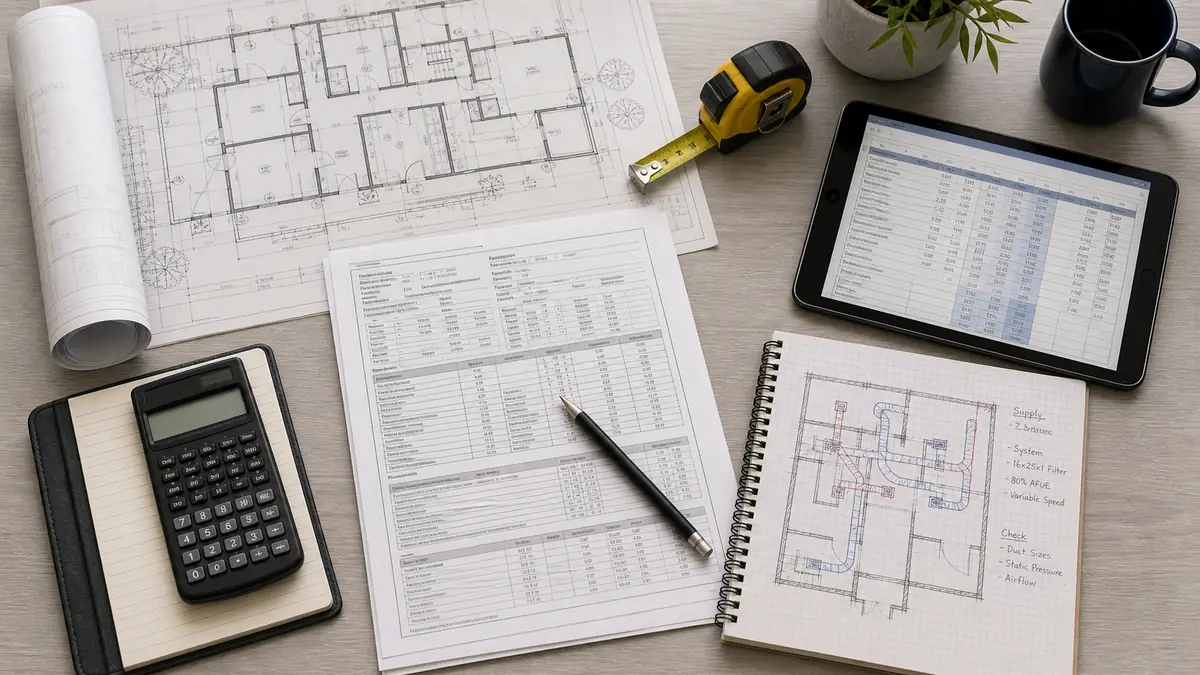
Manual J is the load-calculation standard the trade sizes by, pinning down exactly how much heating and cooling one specific house calls for in BTU per hour, then converting to tons (12,000 BTU/h to the ton). Rather than eyeball it off square footage, the method tallies the real gains and losses: insulation in the walls and ceiling, the area and compass direction of every window, air leakage, the people and appliances inside, and the local design temperature. In Alhambra that design figure tracks a Title-24 Climate Zone 9 inland summer - July highs in the 90-to-94 F band, with the packed urban grid kicking in a heat-island bump on top. What lands at the end is a real number to size to instead of a contractor's reflex.
The reason this matters so much in Alhambra is the housing. The city is wall-to-wall 1920s and 1930s construction - Spanish Colonial revival, Tudor revival, Craftsman, and storybook cottages - and these homes behave differently from new tract houses. Thick plaster walls store heat and smooth out temperature swings; deep eaves on a Craftsman shade the windows; mature street trees on the lettered avenues cut afternoon solar gain. All of that lowers the real load. At the same time, original single-pane windows and unsealed attics leak, which raises it. A Manual J weighs both, which is why two identical-looking bungalows can need different equipment.
Why do so many Alhambra homes have oversized systems?
Because going big is the easy, blame-proof sale. Bolt a 4 or 5-ton unit onto every house and you never field a "still too warm" callback on the worst afternoon of the year - the homeowner just overpays forever and is none the wiser. The penalties are real, they are just quiet. An oversized single-stage condenser slams the little bungalow cold within a couple of minutes, trips the thermostat off, and quits before it has run long enough to strip moisture from the air. So the place feels chilly and damp at the same time, then kicks back on minutes later. That on-off-on pattern - short cycling - shoves every start-up surge through the compressor and capacitor and burns them out years early. The bill is higher to buy, higher to run, and higher to fix.
We see this constantly in Mayfair and Emery Park, where a 1,100-square-foot home carries a condenser sized for a house twice its size. The fix when we replace it is not a bigger or fancier unit - it is the right-sized one. If you are chasing this exact symptom, our short cycling page walks the diagnosis.
What goes into a Manual J for an Alhambra bungalow?
A Manual J is an itemized heat-gain and heat-loss budget, and on a 1920s Alhambra home the line items pull in opposite directions. On the load-adding side: original single-pane wood windows (roughly U-1.0 versus U-0.30 on a modern double-pane), unsealed lath-and-plaster wall cavities with little or no insulation, an uninsulated or barely-insulated attic floor, west and south glass taking full afternoon sun, and the Zone 9 design temperature near 94 F plus the heat-island bump. On the load-subtracting side: thick plaster and stucco mass that buffers temperature swings, deep Craftsman eaves and porch overhangs that shade glass, mature street trees on the lettered avenues, and the modest footprint itself. The calculation also counts occupants (about 230 BTU/h of sensible gain each), the kitchen and laundry, and infiltration measured or estimated in air changes per hour. Net it out and a tightened-up 1,150 sq ft bungalow often lands near 1.5 tons, while the same shell left leaky and sun-struck can call for 2.5 - which is exactly why the square-foot shortcut fails here.
That contrast is the whole argument against rules of thumb. The 400-to-600-square-feet-per-ton shortcut assumes an average, leaky, average-glass house; it cannot see that you added attic insulation last year or that a neighbor's two-story addition now shades your west wall all afternoon. Manual J prices those in. We measure rather than assume because in this housing stock the spread between two identical floor plans is routinely a full ton.
Can you show the oversizing math on a real example?
Take a 1,150 sq ft Emery Park bungalow we right-sized. The rule of thumb at 500 sq ft per ton penciled a 2.3-ton unit, and the prior installer had rounded that up to a 3-ton Comfort 16 condenser to be safe. The Manual J, accounting for the new attic insulation, deep eaves, and shade trees, came back at 21,800 BTU/h - about 1.8 tons. The 3-ton unit was oversized by roughly 60 percent against the real load. The result the owner lived with: two-to-four-minute cooling bursts, a clammy 74 F that never felt dry, a capacitor replaced twice in six years, and a summer bill higher than a neighbor's larger home. We replaced it with a right-sized 2-ton system (a half-ton of cushion for the worst design day) and the run times stretched to ten-to-fifteen-minute cycles that actually dehumidified. Same comfort target, far less wear, lower bill.
The failure chain is mechanical, not mysterious. Oversized capacity satisfies the thermostat before the coil has run long enough to wring moisture out, so the air is cold but damp. The short bursts mean frequent compressor starts, and each start draws locked-rotor inrush current that ages the compressor windings and cooks the run capacitor - the part we replace most in this city. The fix is never a part swap; it is sizing the next system to the house.
How do you size a Carrier system for a small Alhambra lot?
We run the Manual J, then match it to a Carrier tier and tonnage that fits both the load and the physical lot. The table below shows rough starting points; the real number comes from the calculation.
| Home size and type | Typical load | Carrier fit |
|---|---|---|
| 900 - 1,200 sq ft bungalow | ~1.5 - 2 tons | 26SCA / 27SPA or single ductless head |
| 1,200 - 1,600 sq ft | ~2 - 2.5 tons | 26SPA / 26TPA two-stage |
| 1,600 - 2,200 sq ft (some tracts) | ~2.5 - 3.5 tons | 26VNA / 27VNA variable-speed |
| Plaster home, no ducts | Per-room load | Multi-zone ductless or 37M crossover |
Where ductwork exists, we also check duct sizing - an oversized condenser on undersized ducts compounds the airflow problem and trips code 44.
What does Title 24 add to the sizing conversation?
California's energy code layers on top of the federal equipment floor. In the DOE Southwest region - DOE's strictest for cooling - a split AC under 45,000 BTU has to reach 14.3 SEER2 / 11.7 EER2 at minimum, and an air-source heat pump has to reach 14.3 SEER2 / 7.5 HSPF2. Past the efficiency number, Title 24 generally calls for refrigerant-charge and airflow verification on new and replacement split systems, and any duct alteration pulls in duct sealing checked by an independent third-party HERS rater in the field. None of that rescues a botched size - it only certifies that the installed system is charged right and moving air right. Because the climate zones map to CEC weather stations rather than city lines, we pin down the zone by street address. The rebate and SEER2 specifics live in our SEER2 and rebates guide.
How does sizing interact with ductless retrofits?
For the many Alhambra homes with no usable ductwork, sizing happens room by room rather than whole-house. A multi-zone Carrier ductless system or a 37M crossover lets us match a head to each space's load, so a sunny west bedroom and a shaded north study get different capacity. This zoned approach naturally avoids the oversizing trap, because you are not forcing one big central unit to serve rooms with very different needs. It is one more reason the ductless path - covered on our heat pump installation page - fits this city's pre-war stock so well. When the sizing and the equipment both match the house, the result is longer, quieter cycles, real humidity control, and parts that last their full service life.
Common questions
What size AC does a 1,200 square foot Alhambra home need?
Run the Manual J and plenty of 1,100 to 1,400 square foot Alhambra bungalows settle near 1.5 to 2.5 tons, well under the 3 to 5 tons some installers pencil in. Where it lands turns on insulation, how much glass you have and which way it faces, shade, and how leaky the envelope is. Treat the 400-to-600-square-feet-per-ton shortcut as a place to start, never the verdict.
Why is bigger not better for HVAC sizing?
A unit that is too large chills the air in a hurry, then quits before it has wrung any humidity out, leaving the rooms cold and clammy. Those short cycles age the compressor and capacitor ahead of schedule, and you pay more to buy and to run the thing. In a small, plaster-heavy 1920s home, that oversizing is the comfort complaint we reverse more than any other.
Does a Manual J calculation cost extra?
We include the load calculation as part of any Carrier replacement or new-install quote in Alhambra - it is how we arrive at the tonnage, not an add-on. A standalone Manual J for design or a second opinion can be quoted separately. Either way, it is cheaper than living with a wrongly sized system for fifteen years.
Can a variable-speed Carrier unit fix an oversizing problem?
Partly. A Greenspeed variable-speed condenser modulates down to a fraction of capacity, so even if it is rated higher it can run gentle, long cycles that dehumidify well. It is more forgiving than a single-stage unit. But correct sizing still beats oversizing-plus-modulation on cost and longevity, so we size first and use variable-speed for comfort, not as a band-aid.
How does air leakage in an old Alhambra home change sizing?
Vintage homes bleed air through original windows, cracked plaster, and unsealed attics, which pushes the calculated load up. Many of the same homes, though, sit under shade trees and deep eaves behind thick plaster, which pulls it back down. A proper Manual J weighs both sides, and that is exactly why two bungalows of the same footprint on one street can call for different tonnage.